For a century, the oil and gas industry was defined by “The Gamble.” Geologists would look at seismic charts, make an educated guess, and spend $100 million drilling a hole in the ocean floor. Sometimes they hit a gusher; sometimes they hit dust. The cost of failure was simply the price of entry.
In 2026, the gamble is gone. It has been replaced by the simulation.
The era of “Wildcatting”—drilling exploratory wells on a hunch—is dead. The supermajors (ExxonMobil, Shell, BP) have moved from a business model based on exploration to a business model based on optimization. The tool driving this shift is the Digital Twin: a dynamic, physics-based replica of every pipe, valve, reservoir, and drill bit, living in the cloud.
We are no longer just drilling for oil; we are drilling for data. And we are doing it virtually, thousands of times, before we ever break ground.
The End of “Easy Oil” and the Cost of Error
To understand the necessity of the Digital Twin, one must look at the geology. “Easy oil”—the shallow, high-pressure reservoirs—is largely depleted. What remains is “difficult oil”: deep-water, high-temperature, high-pressure, or trapped in tight shale formations.
The technical margin for error in these environments is zero. A slight miscalculation in pore pressure can lead to a catastrophic blowout (reminiscent of Deepwater Horizon) or a collapsed wellbore that incinerates $200 million in capital expenditure (CapEx) overnight.
The Digital Twin is the risk mitigation engine. By creating a virtual mirror of the subsurface geology, engineers can “drill” the well in a simulator 500 times. They can encounter every possible problem—stuck pipes, gas kicks, mud losses—in the virtual world. By the time the physical drill bit touches the sea floor, the operation is not an experiment; it is a script.
The Living Asset: Beyond 3D Models
It is crucial to distinguish between a 3D Model (CAD) and a Digital Twin.
- A 3D Model is static. It shows you what the rig looks like.
- A Digital Twin is alive. It is connected to thousands of IoT sensors on the physical asset.
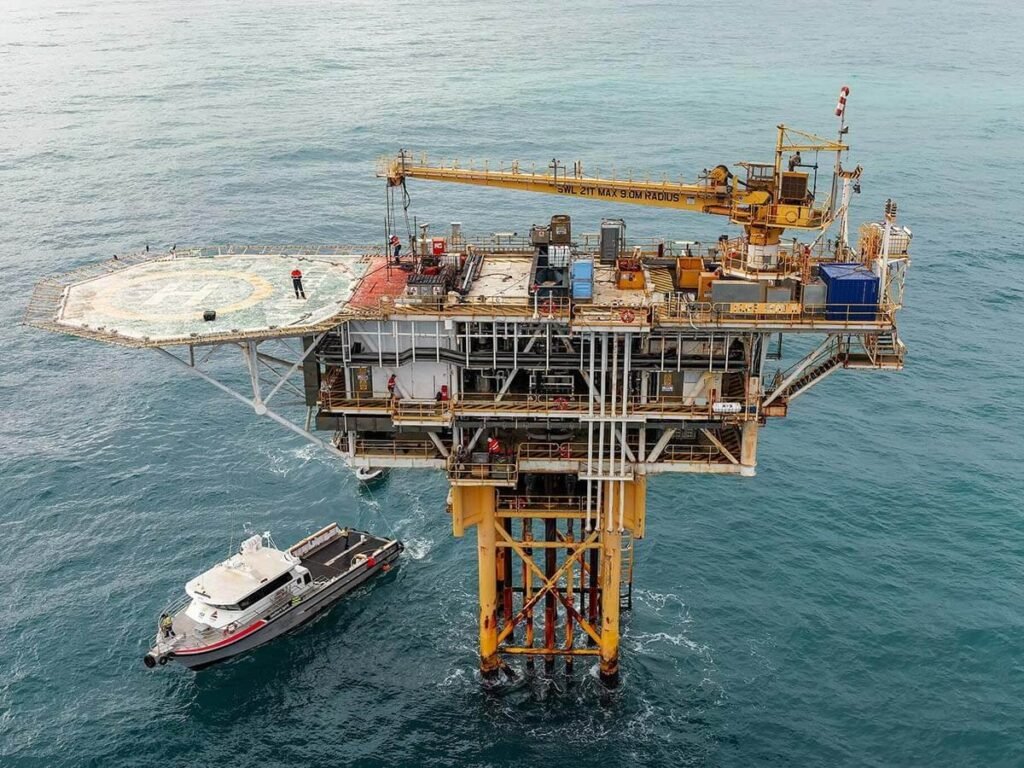
If a pump on an offshore platform off the coast of Guyana starts vibrating at a slightly higher frequency, the Digital Twin in a control room in Houston lights up. The simulation runs a diagnostic: “Given this vibration and the current flow rate, the bearing will fail in 84 hours.”
This moves the industry from Preventive Maintenance (replacing parts on a schedule, which is wasteful) to Predictive Maintenance (replacing parts only when they are about to break).
The Economic Impact: Equinor and BP have reported that Digital Twin implementation on offshore platforms has reduced unplanned downtime by 30%. In an industry where a single day of downtime on a major platform costs $5 million to $10 million in lost revenue, this pays for the technology in weeks.
Destaffing the Offshore: The “Ghost Platform”
The most radical application of this technology is the Unmanned Facility.
Offshore platforms are dangerous, expensive places to keep humans. You need helicopters, catering, sleeping quarters, and complex evacuation protocols. The industry’s goal for 2030 is to have “Normally Unmanned Installations” (NUIs).
The Digital Twin allows this. Because the operators in the onshore control center can “see” the platform in higher fidelity than a human walking the deck (thanks to thermal cameras and acoustic sensors feeding the twin), there is no need for a permanent crew. Robots (like Boston Dynamics’ Spot) walk the rounds, while the humans manage the facility from an air-conditioned office.
This is not just cost-cutting; it is safety. You cannot get injured on a rig if you are not on the rig.
The Decarbonization Angle: Tracking the Invisible
Perhaps the most surprising driver of Digital Twin adoption is the environmental mandate.
Methane leaks are the industry’s Achilles’ heel. Traditionally, leaks were found by a guy walking around with a sniffer device once a month. Today, Digital Twins integrate data from satellite monitoring and continuous point sensors to visualize the “mass balance” of the facility in real-time. If the amount of gas entering the pipe doesn’t match the amount leaving it, the Twin knows exactly where the leak is within seconds.
For companies facing the EU’s strict Methane Regulation (implemented in 2024-2025), the Digital Twin is the compliance tool of record. It proves to regulators that the molecules are staying in the pipe.
The “Drilling” of the Future: Steering by Wire
The cutting edge of this tech in 2026 is Real-Time Geosteering.
As the drill bit cuts through rock 20,000 feet below the surface, it sends data back to the surface via mud-pulse telemetry. This data feeds the Digital Twin, which updates the geological model in real-time.
- Old Way: “We think the oil layer is here, keep drilling straight.”
- New Way: The Twin realizes the rock formation is dipping 2 degrees sharper than predicted. It automatically adjusts the trajectory of the drill bit to stay in the “sweet spot” of the reservoir.
This “snake-steering” increases the “Pay Zone” (the amount of the well exposed to oil) by 20-40%. It is the difference between a profitable well and a dry hole.
Data is the New Barrel
The Oil & Gas majors are rapidly becoming tech companies with a drilling division. The differentiation between Shell and a competitor is no longer just who has the best leases; it is who has the best code.
The Digital Twin has transformed the asset lifecycle. We build it virtually, we crash-test it virtually, and we operate it virtually. The physical steel is just the hardware; the value is in the software that runs it. In 2026, if you aren’t drilling digitally, you aren’t drilling at all.