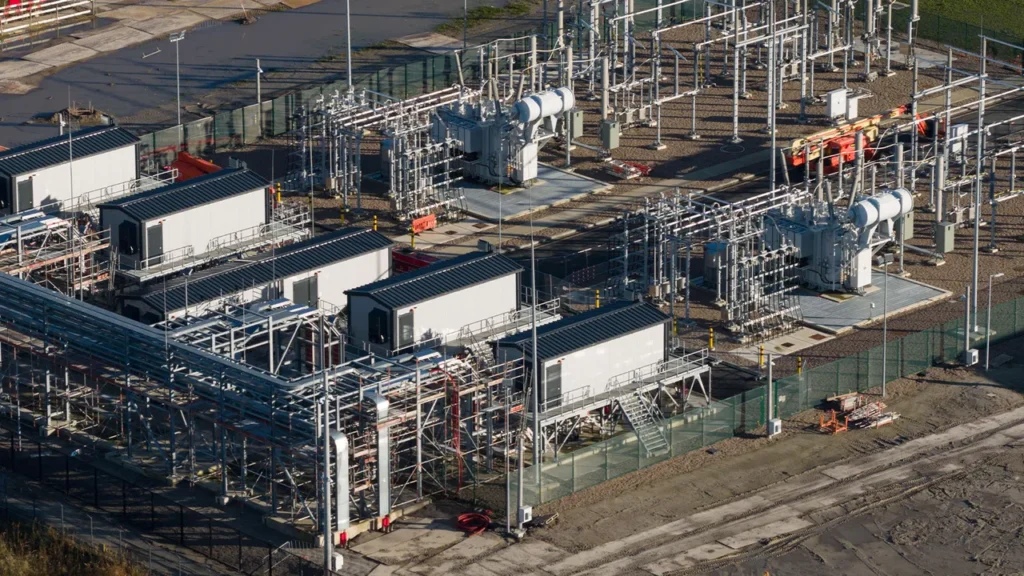
The modern artificial intelligence economy is increasingly constrained not by algorithms, venture funding, or semiconductor supply chains, but by something far older and materially grounded: electricity.
Over the past two years, generative AI has transformed from a speculative innovation cycle into a foundational enterprise technology shift. Organizations across finance, healthcare, manufacturing, telecommunications, cybersecurity, and government are rapidly integrating large language models, multimodal AI systems, and autonomous software agents into core operational workflows. The resulting computational demand has triggered one of the largest expansions of digital infrastructure since the rise of hyperscale cloud computing.
What began as a surge in GPU procurement has evolved into a broader geopolitical and industrial race centered on power generation capacity, grid modernization, cooling systems, and utility infrastructure resilience.
The implications are profound.
AI data center expansion is rapidly reshaping energy markets, altering utility investment priorities, stressing aging transmission networks, and forcing governments to confront uncomfortable questions about industrial policy, sustainability targets, and national competitiveness. The issue is no longer isolated to Silicon Valley hyperscalers or cloud providers. It now sits squarely within boardroom discussions among CIOs, energy regulators, institutional investors, infrastructure planners, and sovereign policymakers.
The sheer scale of projected electricity demand associated with AI infrastructure has become difficult to ignore. According to estimates from the International Energy Agency, global electricity consumption from data centers, cryptocurrency, and AI workloads could more than double by 2026, with AI emerging as the dominant growth driver. Analysts at Goldman Sachs have projected that global power demand from data centers could rise by as much as 160% by the end of the decade. McKinsey estimates that demand for AI-ready data center capacity may triple before 2030.
These forecasts are beginning to reshape investment behavior across multiple sectors simultaneously.
Utility companies are accelerating grid expansion plans. Nuclear energy is re-entering strategic infrastructure discussions. Renewable developers are seeing hyperscalers emerge as anchor customers for massive power purchase agreements. Private equity firms are aggressively acquiring land parcels near transmission corridors. Semiconductor firms such as NVIDIA have become indirectly linked to regional energy economics because every new generation of AI accelerators dramatically increases rack-level power density.
The AI economy, in effect, is becoming an electricity economy.
This shift is particularly visible in regions that historically positioned themselves as data center hubs. Northern Virginia, already home to the world’s largest concentration of hyperscale facilities, is experiencing mounting concerns over transmission bottlenecks and utility strain. Ireland’s grid operator has warned about the sustainability of continued data center concentration near Dublin. Singapore temporarily restricted new data center development because of power and land constraints before reopening approvals under stricter efficiency frameworks. Similar debates are emerging across Amsterdam, Frankfurt, Tokyo, and parts of the Gulf region.
The challenge is not simply one of scale. It is one of synchronization.
AI infrastructure growth is moving faster than traditional utility planning cycles. Hyperscalers can deploy billions of dollars into data center construction within quarters. Expanding generation capacity or transmission infrastructure often requires years of regulatory approvals, environmental assessments, and engineering work. This asymmetry is becoming one of the defining operational tensions of the AI era.
Why AI Workloads Are Fundamentally Different
Traditional enterprise data centers were designed around relatively predictable computing patterns. Even large cloud environments historically optimized for mixed workloads with moderate power density. Generative AI changes those assumptions entirely.
Training frontier AI models requires massive clusters of GPUs operating continuously for weeks or months. Inference workloads, once considered comparatively lightweight, are also becoming increasingly energy intensive as enterprises deploy AI copilots, real-time search augmentation, autonomous agents, and multimodal systems at scale.
The infrastructure profile of these workloads is materially different from earlier cloud computing cycles.
A single advanced AI server rack can consume upwards of 40 to 80 kilowatts of electricity. Emerging GPU architectures may push those numbers even higher. By comparison, traditional enterprise racks often operated below 10 kilowatts. The transition toward liquid cooling systems, high-density networking fabrics, and specialized AI accelerators is fundamentally changing data center engineering economics.
Figure 1: Estimated Rack Power Density Evolution
| Infrastructure Era | Average Rack Density |
| Traditional Enterprise IT (2015) | 5–8 kW |
| Cloud-Native Infrastructure (2020) | 10–15 kW |
| Early AI Training Clusters (2023) | 20–40 kW |
| Advanced Generative AI Clusters (2026 Projected) | 50–120 kW |
The energy implications extend beyond the servers themselves. Cooling systems can represent a substantial portion of overall facility power consumption, particularly in regions with warmer climates. Water usage has also become a growing concern. Large AI facilities may require millions of gallons annually for cooling operations, intensifying debates around environmental sustainability and regional resource allocation.
These operational realities are changing the economics of data center site selection.
For years, hyperscalers prioritized latency, tax incentives, fiber connectivity, and land availability. Power access is now becoming the dominant variable. In some regions, utilities are reportedly unable to guarantee new high-capacity connections for several years because existing substations and transmission systems are already approaching limits.
That constraint is creating a new hierarchy within global digital infrastructure markets.
Regions capable of rapidly expanding generation and transmission capacity may emerge as disproportionate beneficiaries of the AI economy. Those unable to modernize infrastructure fast enough risk losing investment to more energy-abundant jurisdictions.
Utilities Are Becoming Strategic Technology Partners
Historically, utility companies operated at a considerable distance from the technology sector. The relationship was transactional and operationally predictable. Data centers consumed electricity; utilities supplied it.
AI is changing that relationship into something far more strategic.
Hyperscale cloud providers are now negotiating multi-decade energy procurement agreements at unprecedented scale. Utilities, in turn, are increasingly designing infrastructure expansion plans around anticipated AI demand. In several markets, power providers are effectively becoming co-architects of digital infrastructure ecosystems.
This transformation is visible across North America.
Microsoft, Google Cloud, and Amazon Web Services have collectively committed tens of billions of dollars toward renewable energy procurement and grid partnerships. Many of these agreements are no longer driven purely by sustainability commitments. They are increasingly tied to securing reliable long-term electricity access for future AI capacity.
Utilities themselves are adapting operational models to meet this demand profile. Some are accelerating natural gas investments to ensure baseload reliability. Others are reviving interest in small modular nuclear reactors. Renewable developers are pairing large-scale solar installations with battery storage to accommodate continuous AI workloads.
The resulting energy mix is becoming politically contentious.
Environmental advocates argue that AI infrastructure growth risks undermining climate targets if utilities rely excessively on fossil fuel generation to meet short-term demand spikes. Technology firms counter that AI-driven efficiency gains across industries could ultimately reduce broader carbon intensity. Both arguments contain elements of truth, which is precisely why policymakers are struggling to balance industrial competitiveness with decarbonization objectives.
The economics are equally complex.
Electricity demand growth in many developed markets had remained relatively flat for years due to efficiency improvements and slower industrial expansion. AI has abruptly reversed that trend. Utilities that once worried about stagnant growth are now forecasting significant increases in industrial electricity consumption.
Figure 2: Estimated Global Data Center Electricity Demand
| Year | Estimated Consumption |
| 2020 | ~200 TWh |
| 2023 | ~340 TWh |
| 2026 (Projected) | ~620–800 TWh |
Source references: International Energy Agency, Goldman Sachs Research, industry estimates.
For investors, this dynamic is creating unusual convergence between sectors traditionally analyzed independently. Utility companies are increasingly being evaluated through the lens of digital infrastructure growth. Meanwhile, technology infrastructure valuations are becoming partially dependent on energy market assumptions.
The boundary between energy infrastructure and computing infrastructure is disappearing.
The AI Infrastructure Arms Race
The competitive landscape surrounding AI data center expansion has intensified dramatically since the public release of generative AI systems in late 2022.
Cloud providers are now engaged in one of the largest infrastructure spending cycles in technology history. Capital expenditures among major hyperscalers have surged as firms compete to secure GPUs, networking hardware, land, power capacity, and engineering talent simultaneously.
Meta has outlined aggressive AI infrastructure expansion plans tied to open-source model development. OpenAI continues to scale compute partnerships to support increasingly sophisticated foundation models. Anthropic has secured multi-billion-dollar cloud commitments linked directly to AI training capacity. Oracle Cloud Infrastructure is positioning itself as a high-performance AI infrastructure provider for enterprises requiring specialized compute environments.
Yet the most important competitive variable may not be model quality alone.
It may be access to electricity.
Several industry analysts now describe power availability as the emerging bottleneck for hyperscale AI expansion. In practical terms, organizations capable of securing large-scale energy access may gain structural advantages in AI deployment speed and operational economics.
This is already influencing geographic diversification strategies.
Hyperscalers are increasingly evaluating regions with abundant renewable resources, lower electricity costs, and faster permitting environments. Nordic countries, parts of Canada, the Middle East, and select Asia-Pacific markets are attracting renewed attention because of favorable energy profiles.
Saudi Arabia and the United Arab Emirates, for example, are investing aggressively in AI infrastructure while leveraging significant energy capacity and sovereign capital resources. Nordic markets offer relatively low-cost renewable electricity and naturally cooler climates that reduce cooling expenses. In the United States, states with favorable regulatory environments and expanding power infrastructure are seeing substantial increases in hyperscale development activity.
This competitive landscape also extends into semiconductor design.
The efficiency of AI accelerators is becoming economically critical because power consumption increasingly determines total operating cost. NVIDIA’s dominance is partially attributable to its ability to deliver performance improvements that justify escalating energy expenditures. Rival chipmakers are emphasizing efficiency metrics alongside raw computational throughput because enterprises now evaluate infrastructure not only on speed but on long-term energy economics.
The AI stack is therefore evolving into an integrated infrastructure equation involving chips, networking, cooling, software optimization, and power systems simultaneously.
Enterprises Are Entering an Era of Energy-Aware AI Strategy
For enterprise CIOs and CTOs, the infrastructure implications of AI adoption extend far beyond cloud budgeting.
Organizations deploying generative AI at scale are beginning to confront a new operational reality: compute-intensive AI strategies may expose businesses to energy market volatility, infrastructure constraints, and sustainability scrutiny.
This is particularly relevant for sectors operating under strict regulatory or operational resilience requirements.
Financial institutions deploying real-time AI analytics cannot tolerate infrastructure instability. Healthcare organizations integrating AI diagnostics face strict uptime expectations. Manufacturing firms using AI-driven automation systems depend on low-latency computational reliability across geographically distributed facilities.
As AI adoption deepens, energy resilience becomes intertwined with enterprise resilience.
This shift is altering procurement strategies. Enterprises are increasingly demanding visibility into cloud provider energy sourcing, regional infrastructure redundancy, and sustainability reporting. Questions that once belonged primarily to facilities management teams are now surfacing in executive technology strategy discussions.
Some organizations are also reassessing hybrid infrastructure models.
The economics of continuously running AI inference workloads may eventually encourage certain enterprises to deploy specialized on-premises AI infrastructure for predictable high-volume tasks. Others may pursue regional workload distribution strategies based on energy pricing and grid reliability.
These decisions carry substantial financial implications.
AI workloads can significantly increase cloud operating costs because GPU-intensive inference remains expensive relative to traditional computing tasks. As utilization grows, organizations may discover that infrastructure optimization becomes as strategically important as model optimization.
This operational pressure is likely to reshape enterprise architecture priorities over the next decade.
Efficiency-focused AI models, workload orchestration tools, energy-aware scheduling systems, and intelligent infrastructure management platforms could become central components of enterprise AI governance frameworks.
The Regulatory Collision Is Coming
Governments worldwide are only beginning to recognize the scale of the infrastructure challenge emerging from AI expansion.
Most existing energy regulatory frameworks were not designed around rapidly scaling computational industries capable of consuming gigawatts of electricity within compressed timelines. The result is growing tension between economic development ambitions and infrastructure limitations.
In Europe, regulators face competing priorities around digital sovereignty, sustainability mandates, and industrial competitiveness. Several jurisdictions are tightening energy efficiency requirements for data centers while simultaneously encouraging AI investment.
The United States confronts different dynamics.
Federal policymakers increasingly view AI leadership as a national strategic imperative tied to economic competitiveness and geopolitical influence. Yet regional utilities and local governments often struggle with permitting complexity, environmental concerns, and infrastructure financing constraints.
China, meanwhile, continues integrating AI expansion into broader industrial planning initiatives while investing heavily in domestic semiconductor and energy infrastructure capacity.
The geopolitical implications are becoming increasingly significant.
Countries capable of supporting large-scale AI infrastructure may gain disproportionate influence within the global digital economy. Access to reliable low-cost electricity could emerge as a strategic national advantage comparable to semiconductor manufacturing capacity or advanced telecommunications infrastructure.
This possibility is reviving debates around industrial policy.
Governments may eventually offer incentives not only for semiconductor manufacturing and AI research but also for power infrastructure directly linked to computational industries. Transmission modernization, renewable generation expansion, and nuclear development could increasingly be framed as digital competitiveness investments rather than solely energy policy initiatives.
The regulatory implications extend beyond infrastructure itself.
Environmental reporting requirements for AI systems are likely to intensify as public scrutiny around energy consumption grows. Enterprises deploying large-scale AI systems may eventually face disclosure expectations related to carbon intensity, water usage, and infrastructure sustainability metrics.
The era of consequence-free computational abundance is ending.
Sustainability Commitments Are Facing a Reality Test
Few issues expose the contradictions of the AI boom more clearly than sustainability.
Major technology companies have spent years positioning themselves as leaders in renewable energy procurement and carbon reduction initiatives. Yet the explosive growth of AI infrastructure is complicating those commitments.
Several firms have acknowledged that rising AI-related energy consumption could delay carbon neutrality targets. Increased reliance on energy-intensive computing workloads is creating operational realities that clash with earlier sustainability assumptions.
This does not necessarily imply corporate hypocrisy. The scale and speed of generative AI adoption exceeded many industry forecasts.
Still, the tension is real.
AI infrastructure growth is forcing difficult trade-offs between innovation acceleration and environmental stewardship. Some utilities are extending fossil fuel generation timelines to ensure reliability amid rising demand. Others are reconsidering previously planned power plant retirements.
The technology industry’s response has been multifaceted.
Hyperscalers continue signing massive renewable power purchase agreements. Investments in advanced cooling technologies are accelerating. Interest in nuclear energy partnerships is increasing, particularly for future baseload AI capacity requirements. There is also growing focus on developing more computationally efficient AI models.
The sustainability debate is therefore evolving from simplistic narratives into more nuanced infrastructure discussions.
A world increasingly dependent on AI may ultimately require enormous investments in clean energy generation, advanced transmission systems, and next-generation grid management technologies. In that sense, AI could simultaneously exacerbate energy challenges while accelerating modernization efforts capable of supporting broader decarbonization goals.
The outcome remains uncertain.
Capital Markets Are Repricing Infrastructure
Financial markets are already responding to the infrastructure transformation triggered by AI.
Data center operators, utility firms, energy developers, semiconductor manufacturers, and industrial infrastructure providers have all experienced renewed investor attention. Private capital is pouring into digital infrastructure assets at extraordinary scale.
Global infrastructure funds increasingly view AI-related energy demand as a long-duration structural investment theme rather than a cyclical technology trend.
This perspective is reshaping valuation assumptions.
Land parcels near substations and transmission corridors are appreciating in strategic importance. Utility firms with expandable generation capacity are attracting heightened interest. Nuclear energy companies are re-entering institutional investment conversations after years of relative marginalization.
Meanwhile, construction firms specializing in advanced cooling systems, transmission infrastructure, and industrial electrical engineering are experiencing rising demand pipelines.
Figure 3: AI Infrastructure Investment Ecosystem
| Sector | Primary Investment Driver |
| Semiconductor Manufacturing | GPU and accelerator demand |
| Utilities | Industrial electricity growth |
| Renewable Energy | Long-term power procurement |
| Data Center REITs | Hyperscale expansion |
| Grid Infrastructure | Transmission modernization |
| Cooling Technology | High-density AI computing |
Private equity firms are particularly active in this space because infrastructure assets offer relatively predictable long-term revenue characteristics compared with traditional technology investments.
The convergence between infrastructure finance and AI economics may ultimately become one of the defining capital allocation stories of the decade.
The Emerging Geography of AI Power
One of the most consequential yet underappreciated outcomes of AI infrastructure expansion is the emergence of a new global geography shaped by energy availability.
Historically, technology ecosystems concentrated around talent density, venture capital networks, and research institutions. While those factors remain important, power infrastructure is becoming an equally decisive variable.
Regions capable of delivering abundant, stable, and relatively inexpensive electricity are gaining strategic relevance.
This could significantly alter global technology investment patterns over time.
Countries with large renewable energy resources may attract disproportionate hyperscale investment. Energy-exporting nations may increasingly seek to move up the value chain by hosting computational infrastructure domestically rather than exporting raw energy alone.
This trend is already visible in parts of the Middle East.
Governments there are pursuing AI infrastructure investments not merely as diversification initiatives but as mechanisms for capturing greater participation within the future digital economy. Similar ambitions are emerging across Southeast Asia and Latin America.
At the same time, infrastructure limitations could constrain growth in historically dominant technology hubs.
If permitting bottlenecks, transmission congestion, or energy scarcity persist in major markets, hyperscalers may accelerate decentralization strategies. This could redistribute portions of global digital infrastructure development toward emerging regions with more flexible energy expansion capacity.
The implications extend beyond economics.
AI infrastructure geography may influence geopolitical alliances, digital sovereignty debates, cybersecurity considerations, and global trade dynamics. Nations increasingly view computational capacity as strategically important infrastructure rather than purely commercial technology investment.
The power grid is becoming part of digital strategy.
The Quiet Return of Nuclear Energy
Perhaps no development illustrates the changing infrastructure calculus more clearly than the renewed interest in nuclear power.
For years, nuclear energy occupied an uncertain position within Western infrastructure policy discussions. High costs, regulatory complexity, and public opposition limited expansion momentum in many markets.
AI may change that equation.
Large-scale AI infrastructure requires reliable baseload electricity that intermittent renewable sources alone cannot always guarantee without substantial storage capacity. As a result, technology firms and policymakers are revisiting nuclear energy as a potential long-term solution for computational power demand.
Small modular reactors, in particular, are attracting renewed attention because of their scalability and lower projected deployment footprints compared with traditional nuclear facilities.
While widespread deployment remains years away, the conversation itself reflects how dramatically AI infrastructure requirements are reshaping energy policy assumptions.
Technology companies that once focused primarily on software ecosystems are now indirectly influencing debates about national energy generation portfolios.
That represents a remarkable shift in industrial influence.
The Operational Risks Enterprises Cannot Ignore
The enthusiasm surrounding AI transformation often obscures the operational vulnerabilities emerging underneath the infrastructure layer.
Power shortages, transmission failures, cooling disruptions, and regional energy price volatility could all materially affect AI-dependent business operations over time. Enterprises building mission-critical AI workflows without accounting for infrastructure resilience may expose themselves to systemic risks.
Cybersecurity concerns also intensify in this environment.
As utilities become increasingly integrated with hyperscale computing ecosystems, critical infrastructure security becomes inseparable from digital infrastructure security. Nation-state actors targeting energy systems could indirectly affect AI availability and cloud reliability.
This convergence elevates infrastructure resilience into a strategic cybersecurity issue.
CISOs and enterprise risk leaders may eventually need to incorporate energy infrastructure dependencies into broader operational continuity planning. The boundaries separating physical infrastructure risk from digital infrastructure risk are steadily dissolving.
AI expansion is not simply a software transformation. It is a civilizational infrastructure transformation with profound operational consequences.
The Next Decade Will Be Defined by Infrastructure Execution
The defining challenge of the AI economy may ultimately prove less about inventing new models and more about sustaining the infrastructure capable of running them.
The industry has entered a phase where computational ambition collides with physical reality.
Electricity generation. Transmission capacity. Cooling systems. Water availability. Land access. Regulatory approvals. Supply chain resilience. Industrial construction labor. These are becoming the limiting variables of technological progress.
That reality is forcing a broader reassessment of how societies think about digital infrastructure.
For decades, software innovation created the illusion that technological advancement could scale independently of physical constraints. The AI era is exposing the opposite truth. Advanced intelligence systems require extraordinary amounts of material infrastructure beneath the surface.
The consequences will ripple across industries for years.
Utilities will evolve into central participants within the digital economy. Energy policy will increasingly influence technology competitiveness. Enterprises will need to integrate infrastructure resilience into AI strategy. Governments will face mounting pressure to modernize grids while balancing environmental commitments and industrial growth objectives.
The AI race is no longer only about algorithms.
It is about who can build, power, cool, finance, secure, and sustain the infrastructure of intelligence itself.
For CIOs, investors, policymakers, and enterprise leaders, that realization changes the strategic conversation entirely.
The future of AI may depend less on theoretical computational possibility and more on whether the world can generate enough electricity to support its ambitions.
For now, the answer remains uncertain.
But the infrastructure race has already begun.
For additional enterprise infrastructure analysis, readers can explore the broader AI and cloud coverage available at Avanmag AI coverage and Avanmag cloud infrastructure insights. Industry research from McKinsey Insights, Gartner Research, and the International Energy Agency continues to provide critical perspective on the intersection of AI infrastructure, energy markets, and industrial modernization.