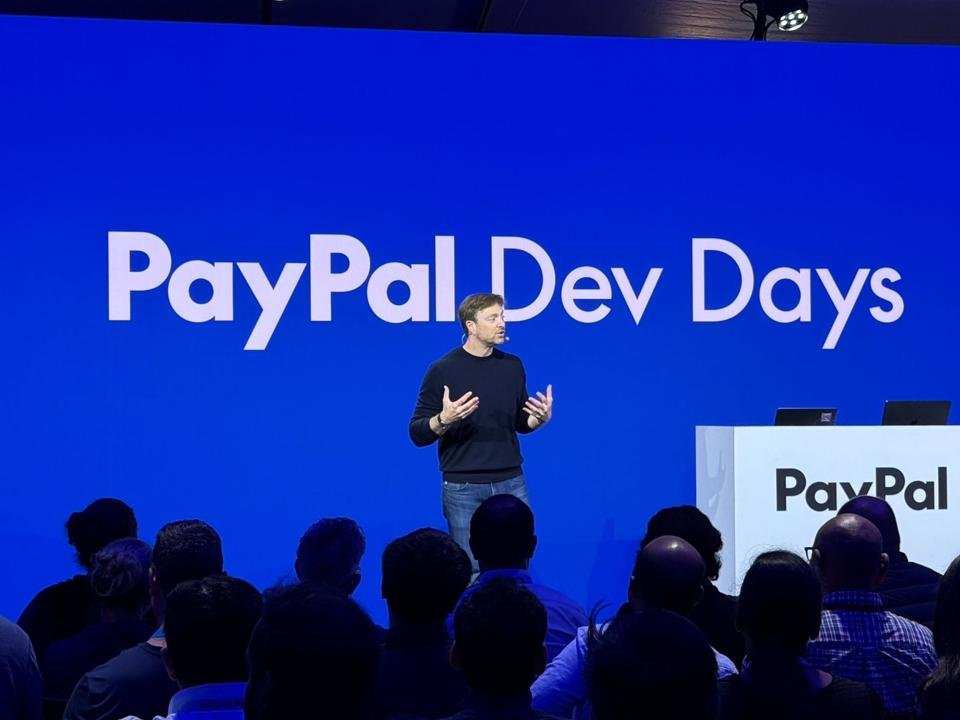
For much of the last decade, PayPal occupied an uncomfortable strategic middle ground in the technology industry. It remained one of the world’s largest digital payments companies, processing hundreds of billions of dollars in quarterly payment volume, yet increasingly struggled to define itself in an ecosystem transformed by embedded finance, real-time payments, cloud-native fintech infrastructure, and artificial intelligence.
The company that once represented the future of internet commerce gradually began to look like an incumbent defending market share against faster-moving rivals. Investors questioned whether PayPal still possessed the product velocity and technological differentiation that once made it synonymous with online payments. Competition intensified from nearly every direction. Stripe expanded aggressively into enterprise merchant infrastructure. Block continued to strengthen its consumer and merchant ecosystems. Apple deepened the reach of Apple Pay across devices and commerce channels. Traditional financial institutions accelerated digital transformation programs while newer fintech entrants targeted profitable niches with highly specialized services.
Against that backdrop, PayPal’s announcement in May 2026 that it was “becoming a technology company again” carried significance far beyond corporate messaging. The statement, delivered amid restructuring plans, organizational simplification, and a major enterprise AI initiative, represented an unusually direct acknowledgment that the company believed it had fallen behind technologically.
The implications are substantial not merely because of PayPal’s scale, but because the company’s pivot reflects a broader shift occurring across the global financial services industry. Artificial intelligence is no longer being treated as an experimental innovation layer inside fintech firms. It is increasingly becoming the operational architecture itself.
PayPal’s restructuring therefore deserves attention not simply as a turnaround story, but as a case study in how mature fintech platforms are attempting to reinvent themselves for an AI-centric era of commerce.
Why the Moment Matters Now
Timing is central to understanding PayPal’s strategic repositioning.
The global payments industry has entered a phase where competitive advantage is no longer determined solely by transaction processing scale or consumer brand recognition. Instead, differentiation increasingly depends on the ability to orchestrate intelligence across fragmented commerce ecosystems in real time. Payments companies are evolving into data infrastructure businesses, fraud intelligence networks, identity orchestration layers, and AI-powered commerce facilitators simultaneously.
This transition has accelerated rapidly since the emergence of generative AI systems capable of reshaping customer interactions, software development, operational automation, and digital commerce workflows.
PayPal’s management appears acutely aware that the next phase of fintech competition will not revolve around simple digital wallet adoption. The battle will increasingly concern who controls the infrastructure enabling AI-native commerce.
That distinction matters.
Historically, payment companies optimized around checkout flows, merchant acquisition, and transaction authorization. AI-native commerce introduces an entirely different paradigm in which intelligent agents discover products, negotiate pricing, execute purchases, verify identities, and manage financial workflows autonomously.
At Google Cloud Next in April 2026, PayPal executives openly discussed rebuilding internal data infrastructure to support “an AI-first world,” emphasizing unified data systems and real-time intelligence capabilities. Meanwhile, the company’s CTO publicly argued that AI had already “rerouted discovery” in commerce, a notable statement because it acknowledges that search behavior itself is shifting toward conversational and agentic systems.
The urgency becomes clearer when examining broader enterprise spending patterns.
According to recent estimates from IDC and Gartner, worldwide AI infrastructure spending is projected to exceed several hundred billion dollars over the next few years, with financial services representing one of the fastest-growing enterprise adoption sectors. Financial institutions are deploying AI not only for customer engagement but for fraud detection, software engineering, underwriting, compliance monitoring, operational automation, and infrastructure optimization.
Figure 1: Estimated Global Enterprise AI Spending Growth
| Year | Estimated Enterprise AI Spending |
| 2022 | $118 Billion |
| 2024 | $214 Billion |
| 2026 | $337 Billion (Projected) |
Source references: IDC, Gartner market projections, enterprise AI investment estimates.
For PayPal, the challenge is compounded by structural realities. Growth in core branded checkout services has slowed. Margin pressure has intensified. Investors increasingly evaluate fintech firms through the lens of operational efficiency and infrastructure leverage rather than pure transaction growth.
The company’s response has therefore combined three interconnected objectives: operational simplification, AI-enabled productivity acceleration, and strategic repositioning around commerce infrastructure.
This is not a superficial AI branding exercise. It is an attempt to redesign the economics of the company.
The Strategic Meaning Behind “Becoming a Technology Company Again”
Perhaps the most revealing aspect of PayPal’s messaging is the implicit admission embedded within it.
When a major Silicon Valley fintech company says it is “becoming a technology company again,” it suggests management believes the organization had drifted toward operational inertia.
That concern has shadowed PayPal for years.
After separating from eBay in 2015, PayPal initially benefited from surging digital commerce adoption and strong secular growth in online payments. Yet over time, the company’s innovation narrative weakened. While competitors launched developer-centric infrastructure ecosystems, embedded financial services platforms, and programmable payment architectures, PayPal often appeared focused on incremental optimization of existing businesses.
The arrival of Enrique Lores as CEO in 2026 appears to have accelerated a more aggressive transformation agenda. Lores’ background at HP, where he pushed subscription models and AI-focused enterprise modernization initiatives, likely influenced his operational philosophy.
Under the new restructuring strategy, PayPal has introduced organizational simplification measures, consolidated business units, elevated Venmo into a standalone division, and created an “AI transformation and simplification” team tasked with driving enterprise-wide AI deployment.
The targeted savings are substantial. Management projects at least $1.5 billion in operational savings over two to three years through restructuring and AI-enabled automation.
Yet the deeper significance lies in how PayPal defines technology leadership internally.
The company is no longer treating AI as an enhancement layer applied selectively to customer-facing features. Instead, AI is being embedded into software engineering productivity, infrastructure management, customer operations, data orchestration, and commerce intelligence.
This aligns with broader trends across enterprise software development. Companies such as Microsoft, Google, and Spotify have increasingly discussed AI-assisted coding and development acceleration as strategic operational capabilities rather than isolated experimentation.
PayPal appears to be pursuing the same model.
Recent technical disclosures from PayPal researchers suggest the company is already deeply engaged in optimizing inference efficiency for internal commerce agents using NVIDIA-based architectures and speculative decoding techniques designed to reduce GPU costs while improving latency performance.
That detail matters because it demonstrates PayPal is investing not merely in off-the-shelf AI tooling but in specialized infrastructure optimization relevant to large-scale commerce systems.
AI as Operational Infrastructure, Not Just Customer Experience
One of the persistent misconceptions surrounding AI adoption in financial services is that the technology’s primary value lies in customer interaction.
In reality, the most immediate economic gains are increasingly emerging from operational transformation.
For PayPal, this appears to be the central thesis.
The company’s restructuring plans indicate a belief that AI can materially reshape internal productivity economics. This includes software engineering automation, organizational streamlining, customer support efficiency, fraud management acceleration, compliance analysis, and platform interoperability improvements.
The implications extend beyond payroll reduction.
Historically, large financial platforms accumulated operational complexity through years of acquisitions, layered systems, fragmented databases, and duplicated workflows. These inefficiencies created organizational drag that limited product velocity and inflated infrastructure costs.
AI offers a mechanism for collapsing some of that complexity.
PayPal’s executives have repeatedly emphasized simplification. That language is important because simplification is fundamentally an infrastructure problem rather than merely a workforce issue.
The company’s data modernization efforts illustrate this dynamic. At Google Cloud Next, PayPal described a multi-year initiative to unify data systems and enable real-time data accessibility across the enterprise.
This kind of data consolidation is foundational for effective AI deployment.
Without integrated data architectures, AI systems struggle to operate consistently across enterprise environments. Financial institutions in particular face severe challenges due to siloed systems, regulatory fragmentation, inconsistent customer records, and complex transaction flows.
PayPal’s modernization strategy therefore reflects a broader truth emerging across financial services: AI transformation is inseparable from infrastructure transformation.
That reality also explains why the company is likely prioritizing cloud-native architectures and operational interoperability alongside generative AI deployment.
Figure 2: Core Areas of AI-Driven Fintech Transformation
| Operational Domain | AI Impact Area |
| Fraud Detection | Real-time behavioral analysis |
| Customer Support | Conversational automation |
| Software Engineering | AI-assisted development |
| Risk Operations | Predictive anomaly detection |
| Commerce Discovery | Personalized recommendation engines |
| Infrastructure Management | Automated optimization |
| Compliance | AI-supported monitoring |
The most strategically important capability may ultimately be orchestration.
Payments companies increasingly function as connective infrastructure between consumers, merchants, financial institutions, regulators, cloud platforms, and commerce ecosystems. AI can enhance the coordination of those interactions at scale.
In that sense, PayPal is attempting to evolve from a payments interface into an intelligent commerce infrastructure provider.
The Competitive Pressure Driving the Transformation
PayPal’s repositioning cannot be understood without analyzing the competitive pressures reshaping fintech globally.
The company faces simultaneous threats from technology giants, fintech infrastructure providers, embedded finance platforms, and AI-native commerce startups.
Among enterprise merchants, Stripe has emerged as one of the most influential infrastructure competitors. Its developer-centric model, API flexibility, and ecosystem integrations made it especially attractive for digital-native businesses. Stripe succeeded partly because it approached payments as programmable infrastructure rather than merely a consumer-facing service.
Meanwhile, Apple’s control over device ecosystems created powerful advantages in mobile payments. Apple Pay benefited from hardware integration, operating system control, and strong consumer trust. Google and Amazon similarly expanded financial and commerce capabilities within broader ecosystem strategies.
Traditional payment networks also remain formidable. According to recent AI adoption assessments in the payments industry, Visa and Mastercard have invested heavily in AI-driven fraud systems, transaction intelligence, and cybersecurity infrastructure.
The scale of those investments is considerable. Visa alone reportedly operates hundreds of AI models and has committed billions toward AI and data initiatives over the past decade.
PayPal therefore confronts a difficult reality: AI adoption is no longer optional competitive modernization. It is becoming table stakes.
The restructuring around Venmo also reveals strategic recalibration. By establishing Venmo as a standalone operational division, PayPal gains greater visibility into performance metrics while potentially increasing optionality around future strategic partnerships or monetization opportunities.
Venmo itself remains strategically valuable because peer-to-peer payment platforms increasingly function as engagement ecosystems rather than simple transfer applications. The intersection of social commerce, embedded financial services, creator monetization, and AI-powered personalization may eventually reshape how these platforms generate revenue.
At the same time, the rise of agentic commerce introduces new competitive uncertainty.
If AI agents increasingly mediate product discovery and purchasing decisions, the traditional checkout experience could become less relevant. Payment providers will need infrastructure capable of supporting machine-to-machine transactions, identity verification, dynamic authentication, and intelligent risk evaluation in real time.
This helps explain PayPal’s growing interest in AI-native commerce architecture.
The company has already discussed enabling shopping and payments inside conversational AI environments, including integrations connected to AI commerce protocols.
That direction is strategically logical. If conversational AI platforms become major commerce gateways, payment providers risk disintermediation unless they integrate directly into emerging ecosystems.
Enterprise Infrastructure and the Economics of AI Fintech
Behind PayPal’s public messaging lies a more consequential enterprise technology story.
AI transformation at global fintech scale requires enormous infrastructure investment.
The economics are complex because financial services companies must simultaneously manage latency requirements, regulatory compliance, cybersecurity obligations, transaction reliability, and escalating compute demands.
Unlike consumer AI startups focused primarily on model experimentation, payment platforms operate under mission-critical reliability expectations. A failed recommendation engine may inconvenience users. A failed payments infrastructure can disrupt commerce globally.
This creates unique operational constraints.
PayPal’s AI initiatives therefore depend heavily on infrastructure modernization. Unified data systems, cloud interoperability, GPU optimization, encrypted architecture design, and real-time processing capabilities all become foundational requirements.
The compute implications alone are substantial.
Generative AI deployment at enterprise scale introduces significant GPU and energy costs. Companies deploying large-scale inference systems must carefully balance latency, throughput, reliability, and operational expense.
PayPal’s research into speculative decoding and optimized inference architectures indicates awareness of these constraints. The company’s experimentation with NVIDIA-based systems and vLLM optimization techniques suggests a focus on operational efficiency rather than pure AI experimentation.
That focus aligns with broader industry concerns surrounding AI economics.
Across financial services, executives increasingly face investor scrutiny regarding the return on AI spending. While enthusiasm for AI remains high, public markets are becoming less tolerant of vague transformation narratives unsupported by measurable operational outcomes.
PayPal’s emphasis on projected cost savings is therefore strategically important.
The company is attempting to frame AI not as speculative innovation spending but as a mechanism for improving operating leverage.
This distinction matters particularly in fintech, where investors increasingly prioritize profitability, margin stability, and disciplined capital allocation after years of growth-oriented spending across the sector.
The Workforce Restructuring Question
No serious analysis of PayPal’s transformation can ignore the labor implications.
The company’s plans reportedly involve workforce reductions approaching 20% over several years.
Management frames these reductions as part of broader organizational simplification and AI-enabled operational modernization. Yet the scale of the cuts highlights a larger industry trend emerging across financial services and enterprise technology.
AI adoption is beginning to alter organizational design itself.
Historically, large technology companies expanded through layered management structures, specialized operational teams, and segmented workflows. Generative AI systems increasingly automate portions of those processes, reducing the need for certain intermediary functions while increasing demand for infrastructure engineering, data orchestration, cybersecurity, and AI governance expertise.
The consequences are uneven.
Some roles become more strategically valuable. Others face compression or elimination. The shift does not necessarily imply mass technological unemployment, but it does suggest substantial workforce reconfiguration.
Financial institutions are particularly vulnerable because many operational workflows involve structured information processing that AI systems can increasingly augment or partially automate.
At the same time, AI deployment introduces new operational risks requiring human oversight.
Fraud management, model governance, regulatory compliance, bias detection, cybersecurity monitoring, and financial accountability remain deeply human-dependent domains. This creates an unusual labor dynamic in which AI simultaneously reduces some operational requirements while increasing demand for higher-order technical and governance expertise.
PayPal’s transformation illustrates this tension clearly.
The company appears to be reducing organizational layers while simultaneously investing more aggressively in engineering modernization and AI capability development.
This mirrors broader patterns emerging across enterprise technology sectors where companies are restructuring around smaller, more technically concentrated operational models.
Regulation, Governance, and the Risks of AI-Native Payments
The payments industry occupies one of the most heavily regulated positions in global commerce.
Any large-scale AI deployment inside financial infrastructure therefore introduces complex governance challenges.
These concerns extend far beyond privacy debates.
AI systems operating within payments ecosystems interact directly with fraud detection, anti-money laundering compliance, transaction monitoring, identity verification, credit assessment, and customer authentication. Errors in these systems can create legal exposure, financial instability, reputational damage, and regulatory intervention.
As PayPal expands AI integration across operations and commerce systems, governance becomes increasingly critical.
Regulators globally are already intensifying scrutiny of AI deployment in financial services. The European Union AI Act, emerging U.S. regulatory proposals, and evolving international standards are likely to impose stricter accountability requirements on AI-enabled financial systems.
This creates strategic tension for companies like PayPal.
Speed matters in AI competition, yet regulatory compliance requires caution, explainability, and operational transparency.
The challenge becomes even more difficult in areas such as agentic commerce where AI systems may increasingly initiate or mediate transactions autonomously.
Questions surrounding liability, consent, authentication, fraud accountability, and algorithmic transparency remain unresolved.
Who bears responsibility if an autonomous agent executes unauthorized transactions? How should AI systems handle consumer disputes? What governance frameworks apply when purchasing decisions become partially automated?
These are not theoretical questions anymore.
PayPal’s positioning suggests the company expects agentic commerce to become materially important over the next several years.
That expectation places governance at the center of infrastructure design.
Financial institutions capable of balancing AI acceleration with regulatory resilience may gain long-term competitive advantages. Those that prioritize speed without sufficient governance safeguards risk significant operational exposure.
The Investor Perspective: Can AI Actually Revive PayPal’s Growth Story?
Investors appear divided on whether PayPal’s restructuring represents a credible strategic reset or a delayed response to years of competitive erosion.
Skepticism is understandable.
The company’s stock performance has struggled amid slowing branded checkout growth, rising competition, and broader fintech valuation compression. Several analysts remain unconvinced that AI alone can restore durable growth momentum.
Yet dismissing the transformation entirely would underestimate the scale of structural change occurring across commerce infrastructure.
PayPal still possesses enormous advantages.
The company operates globally recognized consumer brands, extensive merchant relationships, large transaction datasets, established regulatory infrastructure, and significant engineering resources. Its scale remains difficult for smaller fintech firms to replicate.
The critical question is whether PayPal can convert those assets into an AI-native platform advantage before competitors consolidate market leadership around new commerce paradigms.
Execution will determine the answer.
The company’s restructuring suggests management understands that operational simplification is necessary before technological acceleration becomes possible. Large organizations burdened by fragmented systems often struggle to move quickly even when they possess significant resources.
In that sense, PayPal’s willingness to publicly acknowledge underinvestment in technology may actually strengthen investor confidence over time.
The more difficult challenge involves proving measurable AI-driven business outcomes.
Enterprise investors increasingly demand evidence that AI initiatives improve margins, accelerate product velocity, reduce infrastructure costs, or create differentiated customer experiences. General AI enthusiasm alone is no longer sufficient.
PayPal’s projected savings targets provide one measurable benchmark. Operational efficiency improvements in engineering productivity and infrastructure management could also become important indicators.
Still, growth ultimately matters most.
The company needs to demonstrate that AI transformation enables not merely cost reduction but strategic market expansion.
Commerce Is Becoming Conversational
Perhaps the most important aspect of PayPal’s transformation is its recognition that commerce interfaces themselves are changing.
Traditional e-commerce evolved around websites and applications optimized for human browsing behavior. AI-native commerce may increasingly operate through conversational systems, autonomous agents, embedded assistants, and predictive recommendation engines.
This changes the strategic role of payment infrastructure.
Checkout experiences become less visible when transactions occur through AI intermediaries. Payment providers must therefore integrate more deeply into commerce ecosystems rather than simply processing transactions at the end of purchase flows.
PayPal appears to recognize this shift.
Its investments in AI-powered commerce infrastructure, conversational transaction capabilities, and agentic commerce frameworks indicate an attempt to remain central within evolving digital purchasing environments.
This could ultimately become the most important part of the company’s transformation strategy.
The future of payments may depend less on who owns the consumer wallet and more on who enables intelligent transaction orchestration across distributed AI ecosystems.
That future remains uncertain. Consumer behavior evolves unpredictably. Regulatory intervention may reshape AI commerce models. Infrastructure economics could favor entirely new entrants.
Yet the directional trend appears increasingly clear.
Commerce is becoming more automated, more contextual, and more intelligence-driven.
Payments infrastructure must evolve accordingly.
The Broader Fintech Industry Will Follow
PayPal’s restructuring is unlikely to remain an isolated case.
Across global financial services, companies are confronting similar pressures: operational inefficiency, AI-driven competitive disruption, rising infrastructure costs, and shifting customer expectations.
Many established fintech and banking organizations now face the same fundamental question confronting PayPal: are they truly technology companies, or have they become operationally rigid financial institutions with aging digital interfaces?
That distinction will define the next decade of financial services competition.
AI-native organizations possess structural advantages in speed, data utilization, automation, and operational scalability. Legacy organizations often retain advantages in regulatory infrastructure, customer trust, and balance-sheet strength.
The winners will likely be companies capable of combining both.
PayPal’s transformation therefore reflects a larger industry convergence between fintech infrastructure, enterprise AI, cloud computing, and intelligent commerce orchestration.
This convergence is reshaping not only products but institutional identity itself.
Payments companies increasingly resemble software infrastructure providers. Banks are evolving into data platforms. Commerce systems are becoming AI coordination networks.
The boundaries separating these categories continue to dissolve.
Conclusion: A Reinvention That Carries Industry-Wide Implications
PayPal’s AI-powered turnaround strategy is ultimately about far more than workforce reductions or operational savings targets.
It represents an attempt to redefine what a mature fintech platform must become in an AI-centric global economy.
The company’s leadership appears to understand that payments infrastructure is entering a new phase where intelligence, automation, interoperability, and real-time data orchestration determine competitive positioning as much as transaction scale itself.
That transition will not be easy.
PayPal must modernize infrastructure while maintaining global reliability. It must accelerate AI deployment while satisfying regulators. It must simplify operations without weakening innovation capacity. And it must convince investors that technological reinvention can produce sustainable growth rather than temporary efficiency gains.
Few companies successfully reinvent themselves at PayPal’s scale.
Yet the company’s willingness to publicly acknowledge technological drift may prove strategically important. In many large enterprises, the greatest obstacle to transformation is not technological limitation but institutional denial.
PayPal no longer appears to be denying the scale of the challenge.
Instead, it is attempting one of the most consequential strategic pivots currently unfolding in global fintech: transforming from a digital payments incumbent into an AI-native commerce infrastructure company.
Whether that transformation succeeds will influence not only PayPal’s future, but potentially the future architecture of digital commerce itself.