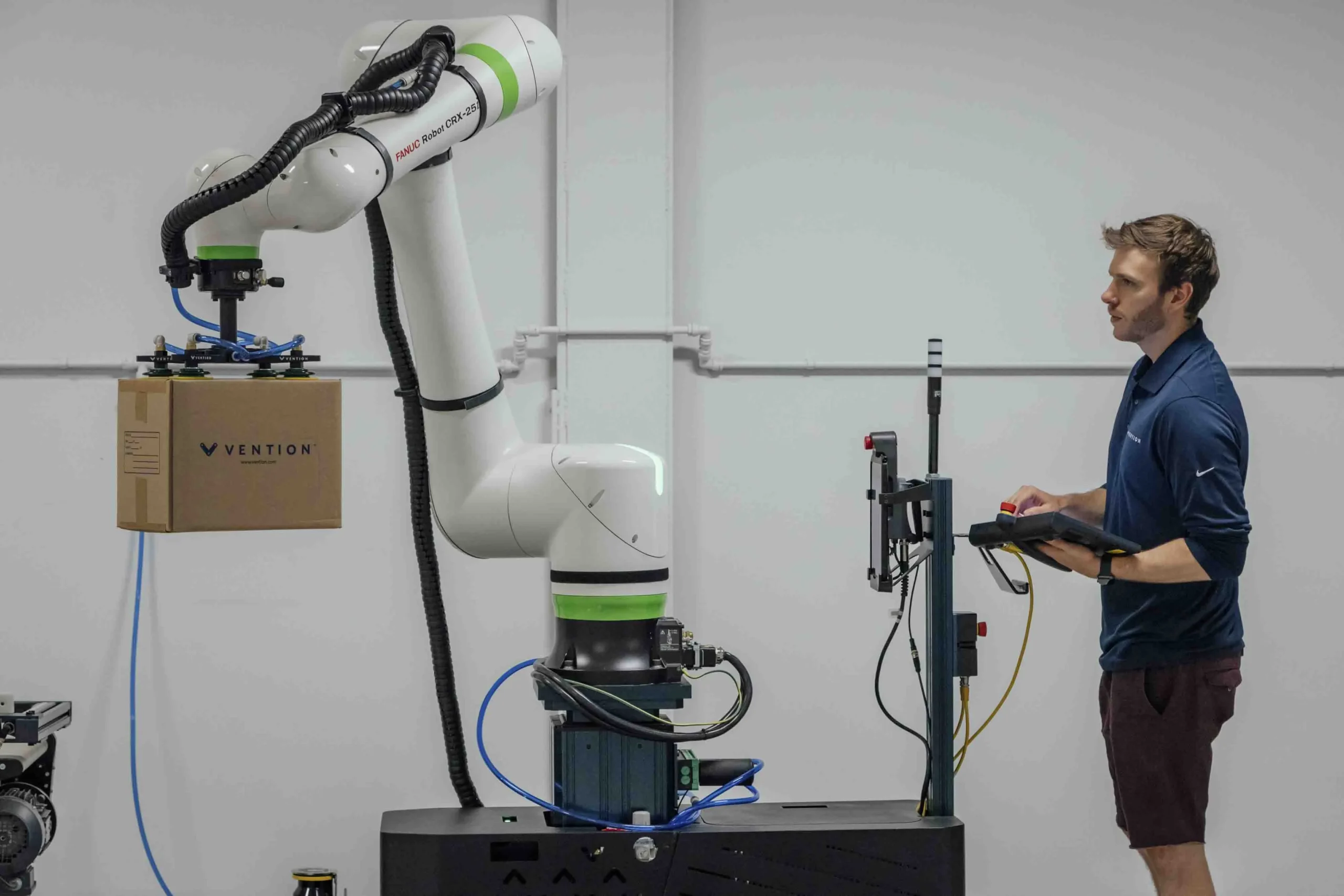
For decades, the prevailing narrative of industrial automation has been one of displacement: a zero-sum game where a machine enters the factory floor and a human worker leaves it. It was a story of cages—literally. Traditional industrial robots, the high-speed titans welding chassis in automotive plants, were powerful, blind, and dangerous. They operated behind safety fences, segregated from the fragile biological entities that programmed them.
That era is effectively over.
As we move into 2026, the manufacturing sector is undergoing a quiet but radical pivot. The cages are coming down. The new capital expenditure (CapEx) cycle isn’t flowing toward massive, isolated automation units, but toward “Cobots”—collaborative robots designed to work shoulder-to-shoulder with humans. This isn’t just a technological upgrade; it is an economic imperative driven by a distinct convergence of demographic collapse, wage inflation, and the maturation of generative AI in edge computing.
The Economic Imperative: Why Now?
To understand the cobot boom, one must look at the labor macroeconomics. The “Global Factory”—China, Germany, Japan, and the United States—is facing a unified crisis: the workers are missing.
According to data from the National Association of Manufacturers, the U.S. alone projects 2.1 million unfilled manufacturing jobs by 2030. In Germany, the Mittelstand is grappling with an aging workforce that is retiring faster than apprentices can be trained. The post-pandemic wage inflation sticky at 4-5% has permanently altered the unit economics of production.
For the CFO, the math has changed. Ten years ago, the ROI on a standard industrial robot arm was calculated over 5 to 7 years. Today, with rising labor costs and the plummeting price of sensor technology, the payback period for a cobot unit—often priced between $25,000 and $50,000—has compressed to under 12 months in high-wage economies.
“We are no longer selling automation as a replacement,” says a lead analyst at a major industrial robotics firm. “We are selling it as a retention tool. You give a welder a cobot to handle the heavy lifting and the toxic fumes, and you keep that welder for another ten years. You don’t, and they leave for a climate-controlled logistics warehouse.”
The Technology Shift: From Scripted to Sentient
The distinction between a robot of 2015 and a cobot of 2026 lies in proprioception—the machine’s sense of self and space.
Early robots followed a deterministic script. If a human arm crossed their path, the robot would not stop; it would strike with thousands of pounds of force. Cobots, pioneered by companies like Universal Robots (owned by Teradyne) and rapidly iterated upon by giants like FANUC and ABB, utilize power-and-force limiting technology. They are covered in sensitive skins and torque sensors. If they bump into a human, they pause immediately.
But the 2026 leap is not mechanical; it is cognitive. The integration of Vision AI and Large Action Models (LAMs) allows these machines to handle unstructured environments.
“The old robot needed a part to be in the exact same millimeter position every time. The 2026 cobot can look at a bin of jumbled parts, identify the right one, orient it, and hand it to a human, adjusting its grip if the human fumbles. That is the holy grail of flexible manufacturing.”
Sector Analysis: Beyond Automotive
While automotive remains the largest install base, the growth story for 2026 is in the “Long Tail” of manufacturing—high-mix, low-volume production.
1. Electronics & SMT (Surface Mount Technology)
The miniaturization of electronics requires precision that taxes human eyesight and dexterity. Cobots are being deployed as “third arms” for technicians, holding micro-components in place while the human performs the complex soldering or quality assurance tasks. This reduces defect rates (PPM) drastically, a critical metric for Apple and Samsung suppliers.
2. Food & Beverage
Sanitation requirements and the repetitive motion injuries associated with packaging have made food processing a prime target. We are seeing wash-down capable cobots working on lines alongside staff, palletizing boxes or decorating cakes—tasks that require a “soft touch” that traditional hydraulics could never achieve.
3. Pharmaceuticals
In cleanrooms, humans are the primary source of contamination. By offloading the movement of samples and petri dishes to cobots, labs can maintain higher ISO cleanliness standards while humans focus on data analysis and experiment design.
The Investment Landscape: Winners and Losers
For the investor, the cobot revolution suggests a reshuffling of the industrial portfolio.
- The Integrators: The real value capture in 2026 may not be the hardware manufacturers (where margins are compressing due to Chinese competition), but the Systems Integrators. These are the engineering firms that customize the cobot for specific factory floors. As implementation becomes the bottleneck, these service-heavy firms possess pricing power.
- The Component Makers: Look upstream. The cobot boom is a boom for harmonic drive systems, torque sensors, and machine vision cameras. Companies dominating the “eyes and hands” of the robot (End-of-Arm Tooling or EOAT) are seeing order books swell.
- The Software Stack: The “OS for Robots” is the next battleground. Just as Microsoft dominated the PC era, the company that provides the standard interface for teaching cobots—moving from complex coding to simple “guided teaching” via tablets or VR headsets—will win the ecosystem.
The Societal Contract: The “Augmented” Worker
The fear of the “lights-out” factory (a factory fully automated with no humans) has largely dissipated among serious industry watchers. It turns out, lights-out manufacturing is brittle. When things break, or when product lines change (which they do constantly in an agile market), you need human adaptability.
The 2026 factory floor is a hybrid environment. The human is the architect; the cobot is the builder. The human is the surgeon; the cobot is the scalpel.
This requires a massive reskilling effort. The job title “Machine Operator” is becoming “Robot Fleet Manager.” The blue-collar worker of 2026 is tech-literate, managing a pod of three to four cobots, troubleshooting errors, and optimizing workflows. This shift commands a wage premium, potentially reversing the decades-long stagnation of industrial wages.
The Collaborative Edge
As we look toward the Q3 and Q4 earnings calls of major industrial conglomerates, expect to hear less about “headcount reduction” and more about “revenue per employee.” The Cobot is the lever that increases that denominator.
The nations and companies that embrace this collaboration will solve the demographic puzzle. Those that cling to the old dichotomy of Man vs. Machine will find themselves with factories that are either too expensive to run or too empty to operate. 2026 is not the year the robots take over; it is the year the robots finally join the team.