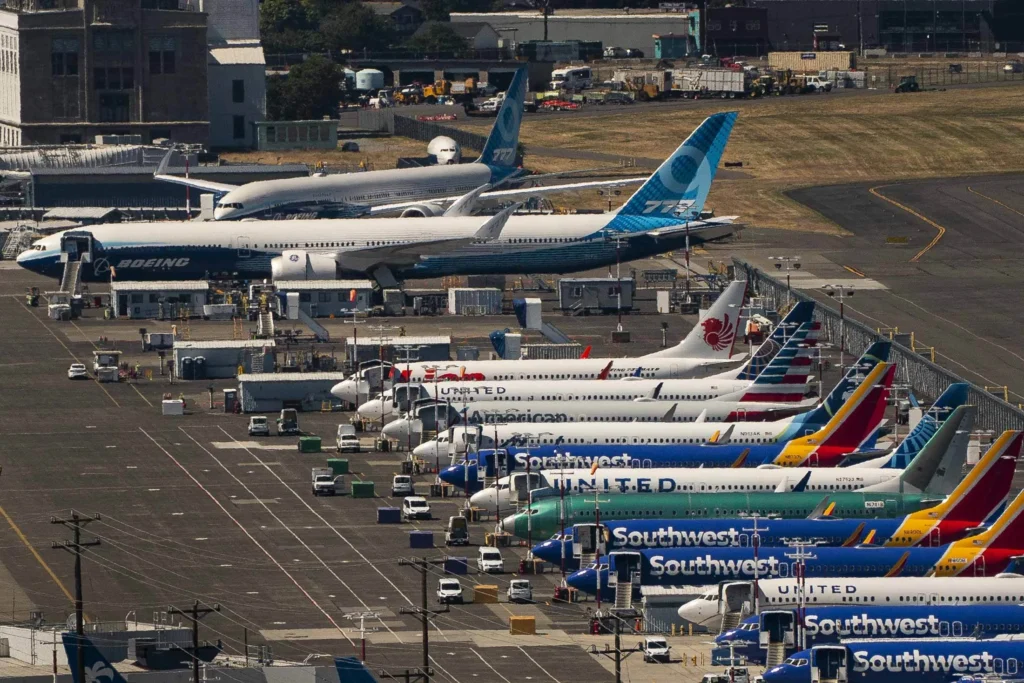
The chaos began on a Tuesday morning that looked like any other. Passengers arrived at airports expecting the routine shuffle of security checks and boarding calls, but instead, they walked into a scene of absolute paralysis. Indigo, the airline that had effectively become the backbone of domestic aviation, had suffered a catastrophic systems failure. This was not merely a glitch or a momentary delay. It was a complete operational meltdown that would ripple across the country for weeks, grounding hundreds of flights, stranding thousands of passengers, and sparking a furious national debate about the reliability of our critical infrastructure. The screens at the terminals, usually flickering with departure times and gate numbers, had turned into walls of red text. “Cancelled” became the only word that mattered.
The immediate aftermath was visceral and panic-inducing. Inside the terminals, the air conditioning struggled to cope with the sheer density of stranded bodies. Families who had packed for vacations found themselves sleeping on cold tiled floors, using their luggage as makeshift pillows. Business travelers, glued to their phones, watched meetings and deals evaporate in real-time. The airline’s app, the primary interface for millions of customers, had crashed under the load of frantic refresh requests. Customer service lines were dead, or worse, trapped in infinite loops of automated apologies. For a solid forty-eight hours, the largest carrier in the nation simply ceased to function as a viable transportation entity. The scale of the disruption was unprecedented, revealing just how heavily the entire transport ecosystem had come to rely on a single dominant player. When the giant stumbled, the earth shook.
What made this crisis particularly stinging was the reputation Indigo had built over the preceding decade. It was the airline that ran on “standard time,” the low-cost carrier that prided itself on military-like precision. It had captured more than half of the market share not by being luxurious, but by being reliable. You booked a ticket, you showed up, and you flew. That unspoken contract was shattered in those few days. The failure was traced back to a cascading software issue in the rostering system—the digital brain that assigns pilots and cabin crew to specific aircraft. When this system went dark, the airline had planes and it had fuel, but it had no idea which pilot was supposed to be in which cockpit. It was a logistical nightmare of biblical proportions. The irony was palpable; a company valued for its operational efficiency was brought to its knees not by a storm or a strike, but by a few lines of corrupted code.
The economic impact of the cancellation wave was immediate and severe. Hotels in major metro hubs like Delhi, Mumbai, and Bengaluru saw a sudden spike in distress bookings, but this short-term gain was dwarfed by the broader economic bleeding. Cargo shipments that rely on the belly space of passenger jets were stuck on the tarmac. Perishable goods rotted in warehouses. The “just-in-time” supply chains of pharmaceutical companies and electronics manufacturers were disrupted, proving that aviation is not just about moving people, but about keeping the pulse of the modern economy beating. Analysts scrambled to quantify the loss, estimating damages in the hundreds of millions of dollars, not just for the airline, but for the wider economy that depends on seamless connectivity. The stock market reacted with predictable brutality, punishing the airline’s valuation and dragging down the entire aviation sector index as investors woke up to the systemic risks hidden in the software layers of these transportation giants.
As the days turned into a week, the crisis evolved from a logistical problem into a public relations disaster. Social media became a battlefield. Videos of distraught passengers arguing with exhausted ground staff went viral, garnering millions of views and fueling a narrative of corporate indifference. The airline’s initial communication strategy—a mix of silence and vague technical jargon—only poured gasoline on the fire. People didn’t want to hear about “rostering software latency”; they wanted to know when they would get home. The disconnect between the corporate boardroom and the chaotic reality at the boarding gates was stark. It highlighted a growing trend in modern corporate crisis management where legal liability often takes precedence over human empathy. The brand damage inflicted during those hundred hours of paralysis may take years to undo, as loyalty in the airline industry is fickle and hard-won.
The regulatory response was swift, though many argued it was reactive rather than proactive. The aviation ministry stepped in, demanding daily reports and issuing show-cause notices. There was talk of mandating “passenger bills of rights” and enforcing stricter compensation norms for delays that are within the airline’s control. This crisis became a catalyst for a much-needed conversation about passenger rights in a monopoly-heavy market. When one airline controls sixty percent of the sky, the consumer has no real alternative when things go wrong. The government began discussing the need to encourage more competition, realizing that allowing a “too big to fail” entity to emerge in the aviation sector was a strategic vulnerability. The monopoly that had once promised efficiency was now a single point of failure for the nation’s transport grid.
Inside the airline, the recovery process was a grueling marathon. IT teams worked around the clock, essentially rebuilding the rostering database from scratch while trying to salvage whatever data they could. Operations managers had to manually map thousands of crew members to flights, using whiteboards and spreadsheets in a throwback to the pre-digital era. It was a humbling reminder that for all our advancements in artificial intelligence and automation, the physical world still requires human intervention when the digital layer collapses. The exhausted crew members, many of whom were stranded alongside passengers without hotel accommodation or information, became the unsung victims of the collapse. Their morale plummeted, leading to a secondary crisis of staff attrition and sickness reporting that further delayed the return to normalcy.
The technical post-mortem of the Indigo crisis revealed uncomfortable truths about the state of enterprise software in critical industries. The drive for cost-cutting had led to a lack of redundancy. Systems were run “lean,” meaning there was no expensive backup system running in parallel, ready to take over instantly. This philosophy of efficiency over resilience works beautifully when things are going well, but it is catastrophic when they fail. The aviation industry, much like the banking sector, is built on legacy code wrapped in modern interfaces. Beneath the slick mobile apps and biometric boarding gates lies a web of aging mainframe architecture that is increasingly difficult to maintain and secure. This event served as a wake-up call for CIOs across every industry, forcing them to ask the uncomfortable question: “Could this happen to us?”
Competitors, naturally, tried to capitalize on the chaos. Other airlines ramped up their flights and uncapped their fares, leading to ticket prices that skyrocketed to extortionate levels. A one-way ticket for a two-hour flight was suddenly costing as much as an international journey. This price gouging, while driven by the algorithms of dynamic pricing, felt predatory to the stranded public. It forced the government to intervene again, capping fares on certain routes to prevent total exploitation of the crisis. This situation exposed the dark side of algorithmic pricing; without human oversight, the market mechanism lacks morality. It simply sees high demand and low supply, and adjusts the price accordingly, indifferent to the fact that the “demand” is driven by a national emergency.
As the dust settled and flights began to return to schedule, the psychological impact on the traveling public remained. The “trust default” had been switched off. Passengers started showing up at airports five hours early, terrified of missing flights. Insurance purchases for travel surged. The assumption that “the flight will leave on time” was replaced by a cynical skepticism. For the airline, the road ahead is steep. They have to prove, flight by flight, day by day, that they are worthy of the nation’s reliance again. They announced massive investments in IT infrastructure and promised a complete overhaul of their digital systems, but promises are cheap. The reality is that confidence is the most fragile currency in the aviation business, and they had just spent their entire reserve.
This event also triggered a broader discussion about the centralization of power in the Indian economy. We have seen similar consolidations in telecom and retail, where one or two giants dominate the landscape. The Indigo crisis showed the tangible danger of this model. When you have a diversified market with five or six healthy competitors, the failure of one is a nuisance. When you have a duopoly or a near-monopoly, the failure of one is a national paralysis. Economists and policy makers began drafting papers on “resilient market structures,” arguing that antitrust laws need to be viewed through the lens of operational security, not just price fixing. The resilience of the nation depends on diversity in its service providers.
Technologically, the industry is now looking toward decentralized systems. The idea of a central database that controls the movement of every pilot and plane is now seen as an archaic risk. Blockchain and distributed ledger technologies are being floated as potential solutions, creating immutable and decentralized records of crew availability that cannot be taken down by a single server failure. While this is still in the conceptual stage, the hunger for a “crash-proof” system is real. Innovation often follows disaster, and this meltdown may well be the genesis of a new, more robust architecture for airline operations management globally.
For the employees of Indigo, specifically the ground staff and cabin crew, the crisis was a traumatic period of abuse and helplessness. They stood at the frontline, absorbing the rage of thousands, often with no information to give. There were reports of staff crying in breakrooms, overwhelmed by the hostility. This highlights a critical failure in crisis protocol—the failure to protect one’s own people. In the future, crisis management playbooks must include specific strategies for empowering and protecting frontline workers, who are often the lowest paid yet bear the highest emotional burden during a collapse. The airline has since initiated counseling programs and “healing workshops,” but the scars of those days will linger in the company culture.
Ultimately, the Indigo flight cancellation crisis of 2025 will be remembered as a turning point. It was the moment when the illusion of seamless modernity cracked. It reminded us that our high-tech world is held together by fragile digital threads. It taught us that efficiency without resilience is a gamble. And it proved that in the end, no matter how advanced our algorithms become, we are still physical beings who just want to get home. The airline will fly again, the stock price will recover, and the headlines will fade. But for those who spent three days sleeping on the floor of Terminal 3, the lesson will not be forgotten. We are only as mobile as the systems we build, and those systems are fallible. The challenge for the future is not just to build faster or cheaper, but to build things that can stand tall when the code breaks.