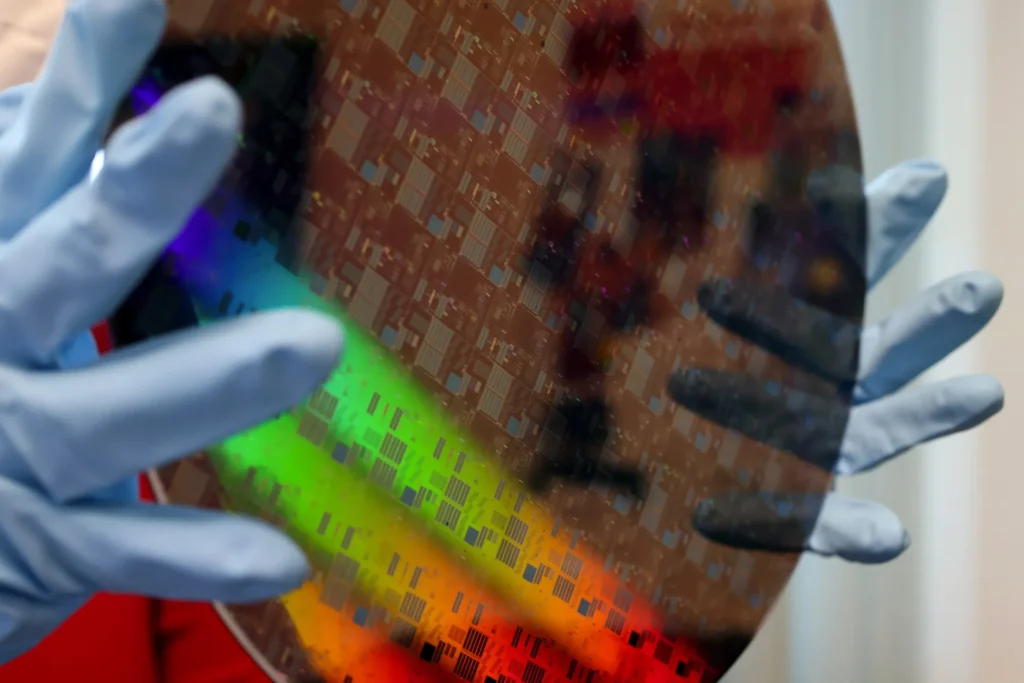
For forty years, the global computing economy operated on a simple feudal model. You paid a “tax” to the lords of silicon—Intel for the CPU, and later, NVIDIA for the GPU. Whether you were Dell, HP, or a kid building a gaming rig, you bought what they sold. The architecture was general-purpose, designed to be “good enough” for everyone, which meant it was perfectly optimized for no one.
In 2026, the serfs have revolted.
We are witnessing the greatest decoupling in hardware history. The world’s largest technology companies—Amazon, Google, Microsoft, Meta, and Tesla—have stopped buying off-the-rack suits and have started tailoring their own. The era of “General Purpose Computing” is yielding to the era of Application-Specific Integrated Circuits (ASICs).
This is not just a technical shift; it is a margin shift. By owning the silicon, these giants are capturing the 50% gross margin that used to go to NVIDIA, and they are using it to build a competitive moat that is effectively uncrossable.
The Hyperscaler Rebellion: Why AWS and Google Walked Away
To understand why this is happening, you have to look at the “Dark Silicon” problem.
A standard NVIDIA H100 GPU is a miracle of engineering, but for a specific workload like serving ChatGPT queries, it is inefficient. It has transistors dedicated to graphics rendering, video encoding, and floating-point math that a Large Language Model (LLM) inference engine never touches. That wasted space consumes power.
In a data center where electricity is 40% of the operating cost, “Dark Silicon” is burning money.
- AWS Graviton & Trainium: In 2026, it is rare to find a generic EC2 instance running on an Intel Xeon chip. Most of the AWS fleet runs on Graviton4 (ARM-based CPU) and Trainium2 (AI accelerator). These chips are designed by Amazon for Amazon. They strip out the legacy x86 bloatware. The result? 40% better price-performance.
- Google Axion & TPU v6: Google hasn’t bought a significant number of ethernet switches in a decade; they build their own. Now, with the Axion processor and TPU v6, they are treating silicon as just another software container. If they update their search algorithm on Tuesday, they can tweak the chip design for the next fabrication run on Wednesday.
The Rise of the “Foundry-less” Chipmaker
Historically, building a chip required a billion dollars and a team of 500 PhDs. You needed a “Fab” (fabrication plant).
In 2026, the “ASIC-as-a-Service” model has democratized silicon.
Companies like Broadcom and Marvell have pivoted. They act as the “general contractor.” A company like Meta comes to them with a blueprint: “We need a chip that only does video transcoding for Instagram Reels.” Broadcom handles the physical layout, the testing, and the booking of capacity at TSMC (Taiwan Semiconductor Manufacturing Company).
This has allowed non-tech companies to enter the game.
- Automotive: Tesla’s FSD (Full Self-Driving) chip was the pioneer. Now, legacy automakers like Ford are designing custom silicon to handle the sensor fusion of their 2027 EV fleets, realizing that using a generic Qualcomm snapdragon chip leaves too much performance on the table.
- Retail: Walmart is piloting custom edge-inference chips for its “Just Walk Out” stores, designed solely to process computer vision feeds for loss prevention without sending terabytes of video to the cloud.
The ARM & RISC-V Insurgency
The weapon of choice for this revolution is ARM architecture, and increasingly, RISC-V.
For decades, Intel’s x86 instruction set was the sticky lock-in. But x86 is proprietary and power-hungry. ARM (owned by SoftBank) licensed its blueprints to anyone. Apple proved with the M-series chips that ARM could beat Intel on performance and battery life.
Now, the market is moving even further open. RISC-V (an open-source instruction set) is the “Linux of Chips.”
- The China Factor: Blocked from buying advanced US chips by sanctions, Chinese tech giants (Alibaba, Huawei) have gone all-in on RISC-V. Because it is open-source, it cannot be sanctioned. In 2026, we are seeing the first competitive RISC-V server chips emerging from Shenzhen, offering a “Sovereign Silicon” alternative to the Western stack.
- The Cost Factor: Using RISC-V saves the massive licensing fees paid to ARM or Intel. For low-margin IoT devices (smart bulbs, industrial sensors), saving $0.50 per chip is the difference between profit and loss.
The Geopolitical Moat: Sovereign Silicon
This fragmentation has profound geopolitical implications. We are moving from a Global Supply Chain to a Bifurcated Supply Chain.
- The US Stack: Designed in California (NVIDIA/Apple/AMD), manufactured in Arizona or Taiwan (TSMC), packed in Mexico.
- The EU Stack: Desperate to avoid irrelevance, the EU is pouring billions into the “European Processor Initiative,” trying to build a sovereign RISC-V accelerator for its supercomputers so it doesn’t rely on American goodwill.
- The China Stack: A completely autarkic ecosystem, using older lithography techniques (7nm instead of 2nm) but compensating with massive specialized architectural efficiency.
If You Don’t Own the Silicon, You’re Just a Tenant
The lesson for the 2026 CEO is stark.
In the cloud era (2010–2020), the competitive advantage was Software. You built a better app on top of AWS. In the AI era (2025–2030), the competitive advantage is Integrated Physics.
If you are running your AI on the same NVIDIA H100s as your competitor, paying the same cloud markup, you have no cost advantage. You are a tenant renting land. The winners of the next decade—whether they are cloud providers, car companies, or defense contractors—are the ones who become their own landlords. They are building the silicon that runs the software that runs the world.