For decades, the global digital economy has rested on a single, fragile assumption: that factoring large prime numbers is mathematically impossible for a computer to do in a reasonable amount of time. Every time you swipe a credit card, send a WhatsApp message, or sign a digital contract, you are betting your security on this one mathematical hurdle.
In 2026, that assumption is effectively dead.
While a commercial-grade quantum computer capable of cracking RSA-2048 encryption (an event industry insiders call “Q-Day”) may still be a few years away—estimates range from 2029 to 2032—the threat is no longer theoretical. It is retrospective.
We are currently living through the largest silent data heist in history, known as “Harvest Now, Decrypt Later” (HNDL). Adversarial nation-states and well-funded criminal syndicates are indiscriminately scraping encrypted traffic from the internet backbone. They cannot read it today. They are simply storing it in massive data centers, waiting for the day the hardware catches up to the math.
If you are transmitting data today that needs to remain secret for more than five years—social security numbers, trade secrets, genomic data, or diplomatic cables—it is already compromised. The lock hasn’t been picked yet, but the burglar has taken the safe home.
The Physics of the Break: Why RSA is Doomed
To understand the magnitude of the shift, we must look at the underlying physics. Our current encryption standards, primarily RSA and Elliptic Curve Cryptography (ECC), rely on “trapdoor functions.” These are math problems that are easy to do in one direction but excruciatingly hard to reverse.
Think of it like mixing paint. It is easy to mix red and blue to make purple. But if you show a classical computer a bucket of purple paint, it cannot easily figure out the exact ratio of red and blue used to create it. This is the basis of public-key cryptography.
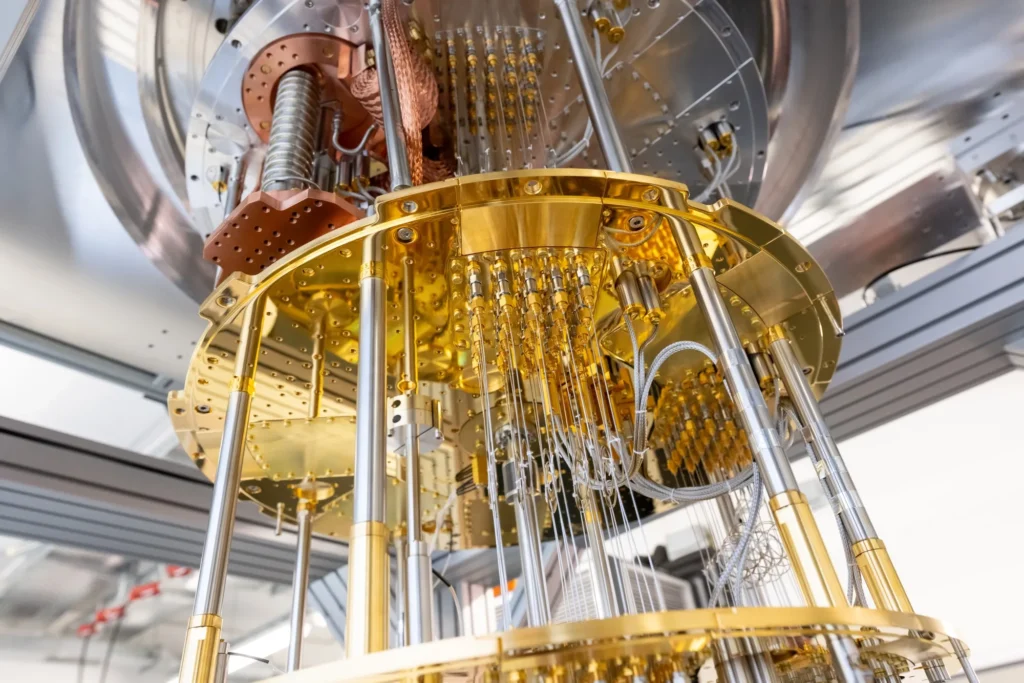
Classical computers process information in binary bits (0s and 1s). To reverse the math, they have to try every possible combination sequentially, which would take billions of years. Quantum computers, however, use qubits that can exist in a state of superposition (representing 0 and 1 simultaneously).
Running Shor’s Algorithm, a quantum computer does not try combinations one by one. It creates a multidimensional interference pattern where the wrong answers cancel each other out and the right answer—the private key—emerges. What takes a supercomputer 10,000 years, a quantum computer with sufficient error correction will do in seconds.
The New Shield: Inside the NIST Standards (FIPS 203, 204, & 205)
The defense against this threat is Post-Quantum Cryptography (PQC).
After a grueling eight-year competition, the U.S. National Institute of Standards and Technology (NIST) finalized the new standards in August 2024. Now, in 2026, these algorithms are mandatory for federal agencies and are rapidly becoming the “Gold Standard” for the private sector.
Unlike RSA, which relies on number theory (factoring), these new algorithms rely on Lattice-Based Cryptography.
Imagine an infinite grid of dots in 500-dimensional space. The “hard problem” here is finding the nearest grid point to an arbitrary location in that space. In two dimensions, this is easy for a human eye. In 500 dimensions, it is a labyrinth that even a quantum computer cannot navigate efficiently.
The three primary weapons in the PQC arsenal are:
- FIPS 203 (ML-KEM / Kyber): This is the workhorse for Key Encapsulation. When your browser connects to a secure website in 2026, this algorithm establishes the shared secret key. It is fast, efficient, and relatively small, making it suitable for everything from servers to smartphones.
- FIPS 204 (ML-DSA / Dilithium): This is the standard for Digital Signatures. It verifies that a software update actually came from Microsoft, or that a bank transaction was authorized by you. It offers balanced performance but requires larger key sizes than the old ECC keys.
- FIPS 205 (SLH-DSA / Sphincs+): This is the fallback. Unlike the first two, it is not based on lattices but on Hash Functions. It is slower and produces massive signatures, but it is a “break glass in case of emergency” option. If a mathematician discovers a flaw in lattice cryptography ten years from now, the world will pivot to Sphincs+.
The Migration Quagmire: The “Y2K” of Cryptography
If PQC is the software patch, why is the industry in a panic? Because cryptography is not just software; it is baked into the hardware.
This is the Cryptographic Migration, and it is infinitely more complex than Y2K.
- Discovery is Hell: Most CISOs in 2026 do not know where their encryption lives. It is hard-coded into legacy mainframes, embedded in IoT sensors on factory floors, and buried in third-party libraries. You cannot upgrade what you cannot find.
- The Hardware Bottleneck: Many Hardware Security Modules (HSMs)—the physical tamper-proof boxes that guard banking keys—do not have the memory or processing power to handle PQC keys. Kyber keys are larger than RSA keys. Dilithium signatures are significantly heavier. Migrating a bank requires physically ripping out and replacing thousands of HSMs in data centers globally.
- Performance Penalties: Early adopters in High-Frequency Trading (HFT) found that the added latency of PQC handshakes slowed down trade execution by microseconds—an eternity in their world. This has sparked an arms race for hardware acceleration (ASICs) specifically designed to run lattice math efficiently.
Sector Spotlight: Who Bleeds First?
While every industry is exposed, three sectors face existential risk.
1. Financial Services & The Blockchain
The global banking system moves $5 trillion a day via SWIFT. If those messages can be decrypted or spoofed, the economy collapses. But the sharper point of the spear is Crypto.
Bitcoin and Ethereum wallets rely on Elliptic Curve signatures (ECDSA) to authorize transactions. These keys are public. A quantum computer could derive the private key from the public key on the blockchain and drain the wallet. In 2026, we are seeing a desperate “Fork or Die” movement in major blockchains to transition to quantum-resistant signatures (like STARKs or lattice-based signatures). The “Zombie Wallets”—the millions of Bitcoin sitting in inactive addresses since 2010—are the biggest risk. If the owners don’t wake up and move their coins to a new PQC wallet, those assets will eventually be stolen by the first quantum actor.
2. Healthcare & Genomics
Your credit card number can be changed. Your DNA cannot. Genomic data is the ultimate “Long-Lived Asset.” A database of 10 million patient genomes hacked today is valuable for 50 years. It can be used to engineer bioweapons or blackmail political figures based on genetic predispositions. Healthcare CISOs are currently prioritizing the encryption of “at-rest” genomic data with PQC, even before they fix their email servers.
3. Critical Infrastructure (OT)
Our power grids and water treatment plants run on Operational Technology (OT) that often has a 30-year lifecycle. A turbine installed in 2010 was not designed to run Kyber-1024. Retrofitting these systems without causing downtime is the primary engineering challenge for the utility sector in 2026.
The Geopolitical Arms Race
This is not just a commercial issue; it is the new Cold War. The U.S. and China are running parallel sprints.
- The U.S. Strategy: Open Standardization. By releasing FIPS 203/204 to the world, the U.S. aims to make its algorithms the global default, ensuring interoperability and allowing Western intelligence agencies to focus on breaking non-standard encryption.
- The China Strategy: Sovereign Algorithms. China has largely ignored the NIST process, developing its own suite of quantum-resistant algorithms and mandating their use in critical infrastructure. We are seeing a “Splinternet” of encryption—a Western Cryptographic Sphere and an Eastern Cryptographic Sphere—that cannot easily talk to each other.
Strategic Action Plan: The Concept of “Crypto-Agility”
For the enterprise leader, the goal is not just “becoming quantum safe.” The goal is Crypto-Agility.
We must assume that even the new algorithms (Kyber and Dilithium) might be broken one day. We cannot afford another 20-year migration cycle. Modern systems must be architected so that the encryption algorithm is a “hot-swappable” component. If Kyber falls on a Tuesday, you should be able to switch to Sphincs+ by Wednesday via a configuration push, not a code rewrite.
The 2026 Playbook for CIOs:
- Inventory Immediately: Use automated discovery tools to map every instance of encryption in your environment.
- Hybrid Mode: Do not switch off RSA yet. Use “Hybrid Encryption” where you encrypt data with both RSA (for classical security) and Kyber (for quantum security). If one breaks, the other holds.
- Vendor Pressure: If your SaaS provider or cloud host is not FIPS 203 compliant, they are a supply chain risk. Vendor risk questionnaires in 2026 have a new “Quantum Readiness” section.
The End of “Set It and Forget It”
Encryption used to be boring. You turned it on, and it worked for a decade. Those days are over.
In the Post-Quantum era, encryption is a living, decaying asset. It requires maintenance, monitoring, and agility. The harvest has already begun. The only question is whether you can change the locks before the burglars finish building their key.