For the better part of the post-war era, the four-year university degree was the “Golden Ticket.” It was the universal signal of employability, a proxy for intelligence, persistence, and social conformity. HR departments used it as a blunt force filter: no Bachelor’s, no interview.
In 2026, the Golden Ticket has lost its sheen. We are witnessing the “Great Unbundling” of higher education.
The shift is driven by a ruthless economic calculation. With tuition costs having outpaced inflation by 170% over the last four decades, and the shelf-life of technical skills shrinking to less than three years, the ROI of a generic degree has collapsed. In its place, a new currency is emerging in the labor market: the Micro-Credential.
We are moving from an era of “Just-in-Case” education (learning everything upfront) to “Just-in-Time” education (learning exactly what you need, right now).
The Signal vs. The Skill
The fundamental problem with the Bachelor’s degree in 2026 is latency.
A computer science curriculum designed in 2022 is obsolete by the time the student graduates in 2026. The tools have changed; the languages have evolved; the AI models have rewritten the workflow. A degree signals that a candidate could learn; a micro-credential signals that a candidate can do.
This distinction has forced a radical change in corporate hiring, led by the “Skills-First” movement. Giants like IBM, Delta Airlines, and Google have famously stripped degree requirements from over 50% of their job postings.
They aren’t lowering standards; they are raising specificity. They don’t care if you read Shakespeare for a semester; they care if you have the Google Cybersecurity Certificate or the NVIDIA Certified Associate in Generative AI. These badges are verified, standardized, and immediately applicable.
The Rise of “Stackable” Careers
The career trajectory of the 2026 worker is no longer linear; it is modular.
The modern resume is becoming a digital wallet of “Stackable Credentials.”
- Layer 1: A foundational certification (e.g., Project Management Professional).
- Layer 2: A niche technical badge (e.g., AWS Cloud Practitioner).
- Layer 3: A soft-skill verification (e.g., McKinsey’s “Problem Solving” badge).
This benefits the employer because it reduces risk. A degree is a black box—you don’t know what the student actually retained. A micro-credential is transparent. If a candidate holds a badge for “Python for Data Analysis,” the employer knows exactly what test they passed to get it.
The “University as a Platform” Pivot
This existential threat has panicked the traditional academy. We are seeing a bifurcation in the university market.
- The Elite: Harvard, Oxford, and Stanford are safe. They sell a network and a brand, not just a curriculum.
- The Middle: The mid-tier private colleges charging $60,000 a year for generic liberal arts degrees are in a death spiral.
To survive, forward-thinking universities are pivoting to become Lifelong Learning Platforms. They are partnering with EdTech giants (Coursera, 2U/edX) to offer “Gateway Certificates.”
Arizona State University and Northeastern University are the blueprints. They allow students to earn industry certifications during their degree, or even better, allow working adults to stack micro-credentials into a degree later. They have realized that in 2026, the “alumni” relationship isn’t about asking for donations; it’s about selling subscription-based upskilling for 40 years.
The Blue-Collar Renaissance: “New Collar” Jobs
The micro-credential boom is not limited to coding. It is revitalizing the trades.
The “Green Collar” transition—hiring armies of electricians to install heat pumps, solar panels, and EV chargers—reaches a bottleneck because trade schools take too long.
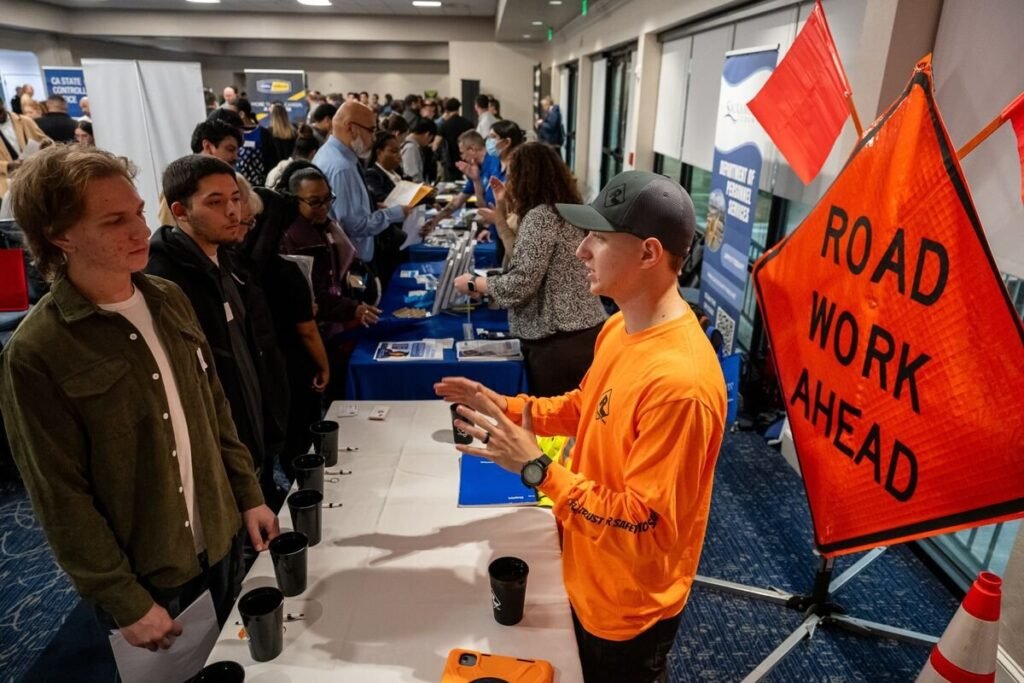
In response, we are seeing the rise of “Apprenticeship-on-Steroids.” Manufacturers and utilities are running 12-week intensive bootcamps. You don’t graduate with a diploma; you graduate with a job offer and a specific certification (e.g., “High-Voltage EV Charger Repair”).
This is rebranding vocational work. It is no longer “blue collar”; it is “New Collar.” It pays six figures, carries zero debt, and is immune to AI automation (ChatGPT cannot fix a broken wind turbine).
The AI Accelerator
Why is this happening now? Artificial Intelligence.
Generative AI has commoditized junior-level knowledge work. Writing basic copy, summarizing reports, or writing basic code is now free. The entry-level white-collar job—the traditional landing spot for the fresh graduate—is evaporating.
To provide value in 2026, a worker needs specialization. A generalist business degree is less valuable than ever. But a specific credential in “Prompt Engineering for Supply Chain Logistics” is highly valuable. Micro-credentials allow workers to pivot into these high-demand niches faster than any university can design a syllabus.
The Death of the “Finished Product”
The cultural shift is profound. We used to view education as a “phase”—you learn from age 6 to 22, and then you work.
In 2026, that model is extinct. If you stop learning at 22, you are unemployable by 30.
The Micro-Credential is the mechanism of agility. It represents the democratization of opportunity—allowing a single mother in Ohio to qualify for a remote cybersecurity job in six months for $300, rather than four years and $100,000. The degree isn’t dead, but its monopoly is broken. The future of hiring is not about where you went; it is about what you can prove.